

TN Visa for Scientific Technician

If you’re a Canadian or Mexican without a degree or diploma but want to work in the United States in a professional capacity, the Scientific Technician TN visa may be your path. The TN Visa for Scientific Technicians allows Canadian and Mexican nationals to work in the U.S. in support of a professional in one of ten (10) specified scientific fields. No bachelor’s degree or Licenciatura is required.
However, the TN Scientific Technician visa is ambiguous. Candidates and employers are often unsure about the eligibility criteria.
This article explores the TN Scientific Technician requirements and everything else you may want to know about this visa category. This includes the required documentation, the application process, and common reasons for denial.
What Is the Scientific Technician / Technologist TN Visa Category?
The Scientific Technician TN visa category is a work visa created under the USMCA (United States-Mexico-Canada Agreement) that allows individuals in specific scientific fields to work in the U.S.
Qualifying individuals must have theoretical knowledge in one of the following fields: agricultural sciences, astronomy, biology, chemistry, engineering, forestry, geology, geophysics, meteorology, or physics. They must also demonstrate that they can apply scientific principles or technical expertise to solve practical problems or perform basic or applied research in one of those fields.
Who Qualifies: Scientific Technician TN Visa Requirements
To qualify for the TN Visa Scientific Technician category, you must meet specific requirements, which include:
- Having theoretical knowledge in an eligible scientific discipline
- Having two years of training or equivalent experience
- Working in direct support of a qualified professional
Requirement 1 – Theoretical Knowledge in an Eligible Scientific Discipline
The TN regulations (8 C.F.R. § 214.6 (c)) state that to qualify for the TN Scientific Technician visa, you must have theoretical knowledge in one of the 10 applicable scientific fields (agricultural sciences, astronomy, biology, chemistry, engineering, forestry, geology, geophysics, meteorology, or physics).
In addition to having theoretical knowledge in one of the ten scientific disciplines, you must also have the ability to solve practical problems in the discipline or be able to apply principles of that discipline to basic or applied research.
Requirement 2 – Two Years of Training or Equivalent Experience
You must have obtained the required theoretical knowledge by completing at least two years of training in a relevant educational program. As proof of successful completion of the required two-year training, you must present a diploma, certificate, or transcript, accompanied by evidence of relevant work experience.
Requirement 3 – Working in Direct Support of a Qualified Professional
Your prospective work in the U.S. as a Scientific Technician/Technologist must be to support a qualified professional directly.
Self-employment is not permitted. You must have a job offer from a U.S. employer. The TN visa scientific technician position must be wholly about providing support to someone who qualifies as a professional in that field and performs scientific or engineering functions in the organization.
The 10 Eligible Scientific Disciplines
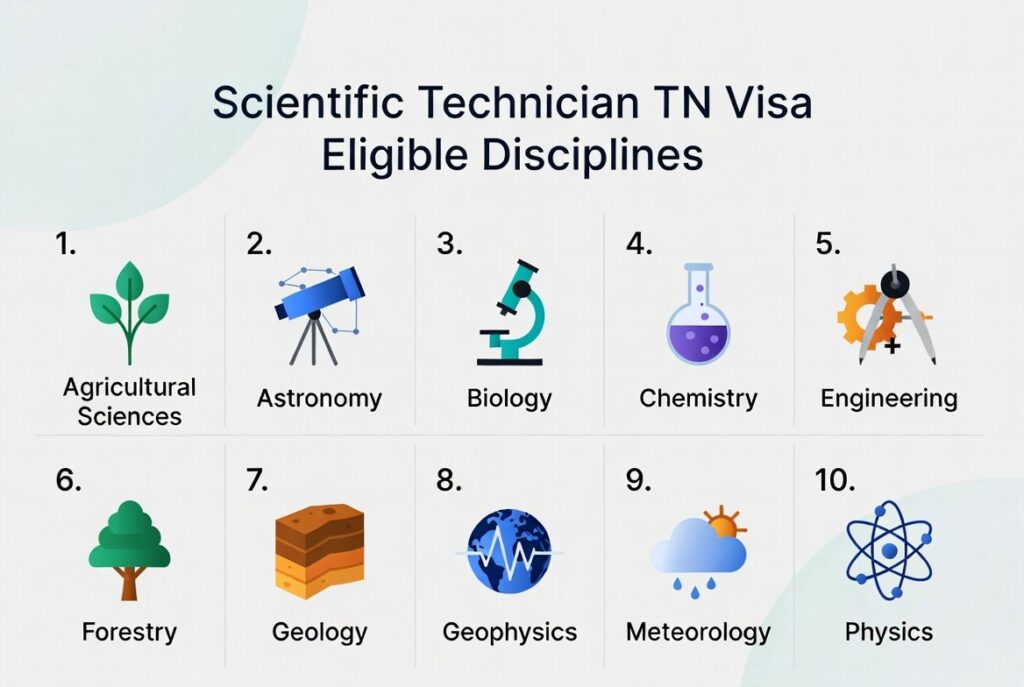
- Agricultural sciences
- Astronomy
- Biology
- Chemistry
- Engineering
- Forestry
- Geology
- Geophysics
- Meteorology
- Physics
Only these ten scientific disciplines qualify for the TN Scientific Technician/ Technologist visa. Any discipline outside these ten does not qualify.
Job Duties That Qualify and Work That Does Not
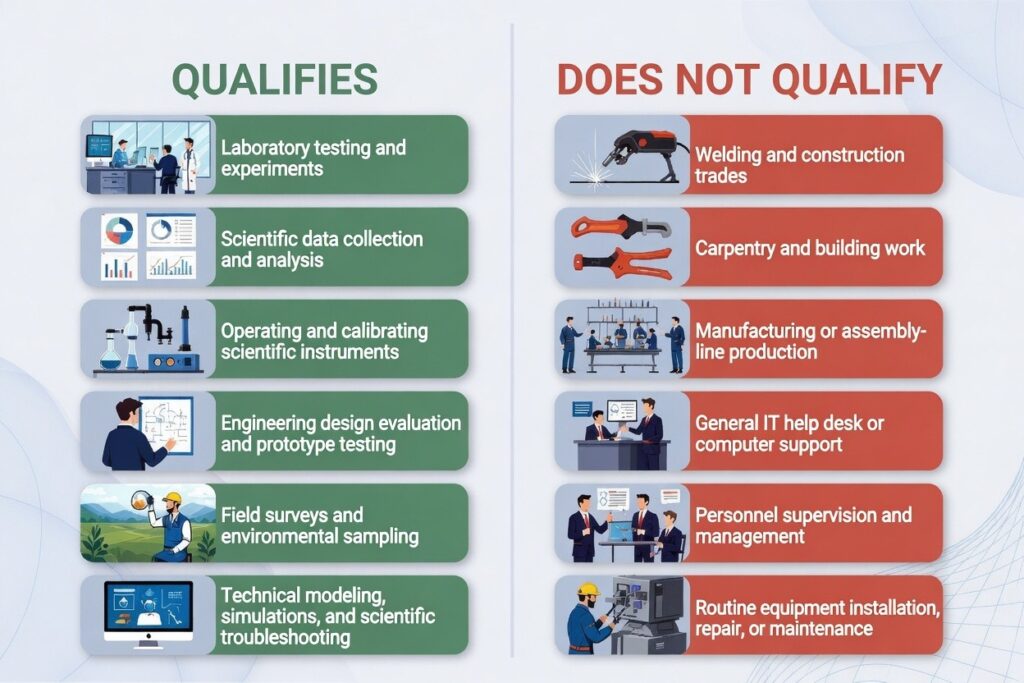
U.S. immigration officers look beyond job titles and focus on the actual duties the TN applicant will perform in the U.S. They rely on the Department of Labor’s Occupational Outlook Handbook (OOH) to determine job duties that qualify in each scientific discipline.
To qualify for the TN Scientific Technician visa, your job duties must be consistent with those of a Scientific or Engineering Technician/Technologist as defined in the OOH. If your prospective job duties involve functions primarily associated with other job titles, you will not be admitted.
Duties That Satisfy the Practical Problems or Applied Research Standard
Simply working in a technical environment is not enough. The position must include applying scientific principles and technical expertise to support research or solve practical problems.
Examples of job duties that satisfy this include:
- Conducting laboratory tests and experiments under the supervision of engineers or scientists.
- Collecting, analyzing, and interpreting scientific or technical data.
- Operating, calibrating, and maintaining specialized scientific instruments and equipment.
- Assisting with engineering design evaluations or prototype testing.
- Performing field surveys, environmental sampling, geological testing, or quality-control inspections.
- Developing technical models, simulations, or measurement systems used in scientific investigations.
- Troubleshooting technical issues and recommending solutions based on scientific methodologies.
Work That Falls Outside This Category
A 2002 INS memo clarifies that positions in the construction trades, such as welders, carpenters, and electricians, do not qualify for the Scientific Technician/Technologist TN visa, even if these trades are specialized to a particular industry.
Generally, any work that wholly involves installation, repair, or maintenance does not qualify for the Scientific Technician/Technologist TN visa, even if the individual is employed by a scientific or engineering organization.
Examples of non-qualifying job duties include:
- Manufacturing, assembly-line, or production work that does not require scientific analysis.
- Information technology support roles that are unrelated to scientific or engineering projects.
- Positions focused primarily on supervising personnel rather than performing technical work.
- Routine equipment operation that does not involve scientific interpretation, testing, or analysis.
Education and Training Requirements
The TN Scientific Technician/Technologist category has unique educational requirements. Unlike virtually every other TN category that requires a bachelor’s degree, TN Scientific Technicians or Technologists may qualify using a combination of specialized training and relevant work experience.
However, applicants must still demonstrate that they possess the technical knowledge necessary to support qualified scientists or engineers in solving practical problems or conducting applied research.
When a Diploma or Certificate Applies
If you don’t have a 4-year degree, you may still qualify for the TN Scientific Technician visa if you have at least two years of post-secondary education and relevant work experience. A diploma or certificate from technical or vocational programs may help establish that you have the specialized knowledge required for the position.
In addition to providing a diploma, certificate, or other documentation of specialized knowledge, you must also be prepared to show that the training is directly related to the scientific or technical duties you will perform.
When Work Experience Substitutes for Formal Training
When you do not have a certificate or diploma to satisfy having theoretical knowledge, extensive work experience may be used. However, cases like this are usually difficult, and they receive closer scrutiny.
To succeed when relying primarily on experience, you must provide not only detailed evidence of your experience but also documentation demonstrating the specialized knowledge gained through your work.
Applying for the Scientific Technician TN visa with only work experience can be challenging. Not sure how to document your experience to meet TN visa requirements? We will review your case before you apply and help you present your experience in a way that clearly demonstrates you qualify for the visa.
The Support Professional Requirement Explained
The 2002 memo from the U.S. Department of Justice’s Immigration and Naturalization Service (INS) clarified the work activities of a TN Scientific Technician. It says
- The TN Scientific Technician/Technologist must provide direct support to an individual who qualifies as a professional in their own right in one of the 10 applicable scientific disciplines.
- The TN Scientific Technician/Technologist work must be interrelated to that of the supervisory professional.
For this reason, immigration officers look beyond an applicant’s discipline and job duties. They also closely examine the relationship between the applicant and their supervising professional.
What Makes a Supervisor a ‘Qualifying Professional’
A qualifying professional is an individual who works in a recognized scientific or engineering profession and possesses the education, credentials, and expertise normally associated with that field. Examples of qualifying professionals are engineers, chemists, physicists, biologists, geologists, and environmental scientists.
What Interrelated Work Means in Practice
TN regulations also require that TN technicians’ work be interrelated to that of the professional they provide direct support to. It further explains that the work of a TN Scientific Technician/Technologist must be managed, coordinated, and reviewed by the professional supervisor and must also provide input to the supervisory professional’s own work.
Unlike many TN professions, Scientific Technicians and Technologists are not permitted to perform independent professional services. They cannot simply do their job and report to a supervisor within a technical department. Instead, the relationship must be one in which the supervisory professional relies on the technician’s work to perform their own scientific or engineering functions.
For example, an engineering technician conducts testing, collects measurements, and prepares technical reports. Then, a supervising engineer uses this work to evaluate product performance or complete design projects.
Application Process for Canadian and Mexican Citizens
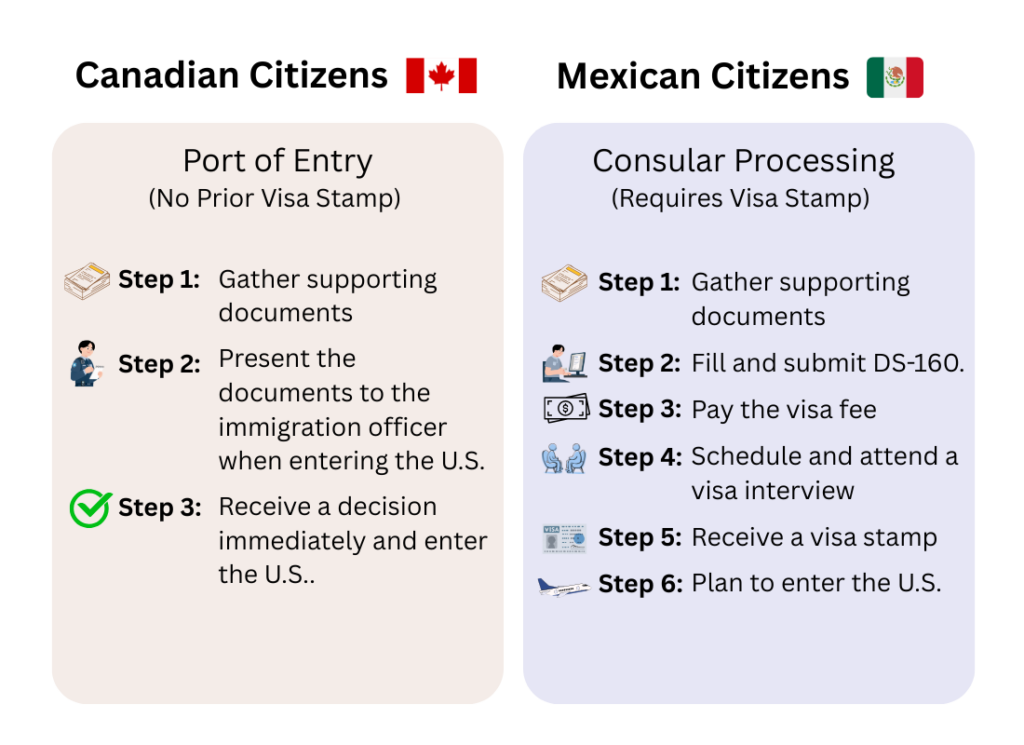
The Scientific Technician TN visa application process differs significantly for Canadian and Mexican nationals.
Canadian Citizens: Applying at the Port of Entry
Canadian citizens may apply for a TN at the port of entry by presenting their TN documentation to immigration officers. The officers will review the application and make a decision about entry on the spot.
Port of Entry applications offer the advantage of speed/fast processing. If you have a strong application package with the right documents, you can enter the U.S. on the same day.
For Canadians applying for the Scientific Technician TN visa, the process is as follows:
Step 1: Gather supporting documents
Step 2: Present the documents to the immigration officer when entering the U.S.
Step 3: Receive a decision immediately and enter the U.S. (if the application is approved).
Mexican Citizens: Consular Processing and the DS-160
Mexicans applying for a TN must do so through the U.S. Embassy or Consulate in Mexico. They must complete the online application form (DS-160), attend a visa interview at the Embassy or Consulate, and receive a visa stamp in their passport before they can enter the U.S.
Consular processing can take between 1 and 3 months, making it slower than Port of Entry applications.
For Mexicans applying for the Scientific Technician TN visa, the process is:
Step 1: Gather supporting documents
Step 2: Fill and submit DS-160 (the online application form)
Step 3: Pay the visa fee
Step 4: Schedule and attend a visa interview
Step 5: Receive a visa stamp
Step 6: Plan to enter the U.S.
Required Documents for a Scientific Technician TN Visa Application
U.S. immigration officers rely on written evidence to determine eligibility, so even highly qualified applicants may face delays or denials if the supporting documents do not clearly demonstrate eligibility.
Documents the Applicant Must Provide
When applying for a TN visa in the TN Scientific Technician/Technologist category, you need the following documents:
- Citizenship documents (a valid passport)
- A diploma or certificate from a recognized technical institute
- Transcript detailing coursework in the relevant scientific/technical program
- A resume highlighting your technical skills and experience
- Letters from your previous employers explaining your job role, responsibilities, and duration.
- Professional training records and industry certifications
- TN support letter from your prospective U.S. employer detailing how you and the role meet the scientific technician TN requirements
What the Employer’s Support Letter Must Include
The TN support letter from your prospective U.S. employer must clearly show that the role is technical in nature, state that it directly supports a degreed professional in science or engineering, and explain how it fits the TN Scientific Technician or Technologist category.
A strong TN support letter must include the following:
- A job title that reflects the scientific or technical work (e.g., Chemical Lab Technologist, Engineering Technician, etc.).
- A brief description of the scientific or technical duties of the job.
- The qualified professional you will support, stating their job title, scientific/technical duties, and how your contributions are essential to their work.
- A statement showing how your education, training, and experience qualify you for the role.
- A statement that the position aligns with the TN Scientific Technician requirements
The employer’s support letter is one of the most important parts of a Scientific Technician TN visa application. Vague or generic letters can lead to denial.
Need a strong support letter that significantly increases your prospective employee’s chances of TN visa approval? Order a support package and work with a team that has guided hundreds of employers through this phase with successful outcomes.
Common Denial Reasons
Some of the common reasons TN Scientific Technician/Technologist applicants get denied are:
- Weak or generic TN support letter: The letter provides only a job title and a general description and does not address TN-specific requirements.
- Failure to explain the scientific nature of the job: The officer cannot clearly see how your work is related to a scientific or engineering discipline.
- Job description does not match the TN category: The job duties align more closely with another TN profession, or with no TN profession at all.
- The position appears too independent: The position appears to involve independent professional work rather than technical support functions.
- Lack of specialized scientific knowledge: The application does not clearly show that you have theoretical and practical knowledge of the relevant scientific discipline.
People who work with immigration lawyers experienced in Scientific Technician/Technologist TN applications generally avoid these mistakes. TNVisaExpert has successfully handled numerous Scientific Technician/Technologist TN cases. Contact TN Visa Expert and get help in preparing a strong support letter and application package.
How Long Does the TN Status Last and How to Extend It
The TN visa is granted for up to three years at a time. And you can always renew it when it expires, as long as you continue to meet all TN requirements.
How you can extend the TN visa depends on whether you are in the U.S. or abroad.
Extending the TN visa while in the U.S
If you are currently in the U.S., your employer may file Form I-129 with U.S. Citizenship and Immigration Services (USCIS) to request an extension of your TN status. If approved, you can keep working with the employer.
Extending while outside the U.S.
If you are outside the U.S., the TN visa extension process is similar to obtaining a new TN. Canadians may apply at a U.S. port of entry, while Mexicans must obtain a new visa stamp at a U.S. consulate in Mexico.
How an Immigration Attorney Can Strengthen Your Application
An experienced immigration attorney helps ensure your application is structured in a way that aligns with TN classification requirements. This includes:
- Review your credentials and experience, and advise whether you qualify under the Scientific Technician/Technologist TN category
- Draft a strong employer support letter
- Ensure that job titles and duties are presented in a way that matches TN expectations
- Anticipate and address common denial issues such as vague descriptions, mismatched job duties, supervision issues, scientific role issues, and more.
- Ensure consistency across all documents
- Strengthen your evidence of qualification by advising on key evidentiary documents to include.
Obtain TN Visa legal support today!
Frequently Asked Questions

Author Jacob Sapochnick serves as the Managing Partner/CEO of a prominent law firm that focuses on immigration law. Boasting an extensive legal background spanning over a decade, he adeptly merges his enthusiasm for law with cutting-edge technology to aid clients worldwide in their journey to immigrate to the United States.